Since 1977

Since 1977, I have written more than 300 000 kilometers of words, that is to say put end to end, one way trip from Earth to the Moon. Or a second to light for this trip. A second light words in 30 years, some 3 billion signs.

Saturday, April 22, 2017

LEV YASHIN: " THE BLACK SPIDER".

LEV YASHIN  ( The Black Spider ).
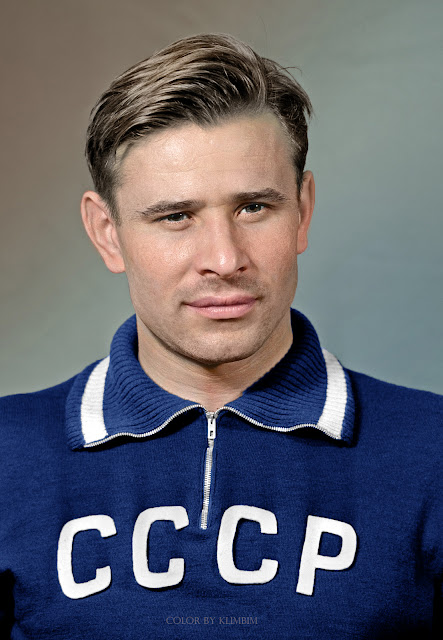


Lev Ivanovich Yashin (Russian: Лев Ива́нович Я́шин, 22 October 1929 – 20 March 1990), nicknamed the "Black Spider" or the "Black Panther", was a Soviet-Russian football goalkeeper, considered by many to be the greatest goalkeeper in the history of the game. He was known for his athleticism, stature, imposing presence in goal, and acrobatic reflex saves. He was also deputy chairman of the Football Federation of the Soviet Union.

Yashin earned iconic status for revolutionizing the goalkeeping position by stamping his authority on the entire defense. He shouted orders at his defenders, came off his line to intercept crosses and also ran out to meet onrushing attackers, done at a time when goalkeepers spent the 90 minutes standing in the goal waiting to be called into action. His performances made an indelible impression on a global audience at the 1958 World Cup, the first to be broadcast internationally. He dressed head to toe in black, thus earning his nickname the 'Black Spider', which enhanced his popularity.

Yashin appeared in four World Cups from 1958 to 1970, and in 2002 was chosen on the FIFA Dream Team of the history of World Cups. In 1994, he was chosen for the FIFA World Cup All-Time Team, and in 1998 was chosen as a member of the World Team of the 20th Century. According to FIFA, Yashin saved over 150 penalty kicks in professional football – more than any other goalkeeper. He also kept over 270 clean sheets in his career, winning a gold medal at the 1956 Olympic football tournament, and the 1960 European Championships. In 1963, Yashin received the Ballon d'Or, the only goalkeeper ever to receive the award. He was voted the best goalkeeper of the 20th century by the IFFHS.


Early life

Yashin was born in Moscow to a family of industrial workers. When he was 12, the Second World War forced him to turn to factory work to aid in the war effort. However his health at the age of 18 meant he was unable to work. Thus, he was sent to work in a military factory in Moscow, where he played for its football team. It was there that he was spotted and invited to join the Dynamo Moscow youth team.


Club career

Yashin’s debut for Dynamo came in 1950 in a friendly match. It was not the debut he would have hoped for, as he conceded a soft goal scored straight from a clearance by the opposing keeper. That year he played in only two league games, and did not appear in a senior match again until 1953. But he remained determined, and stayed at Dynamo in the reserves waiting for another opportunity. Yashin also played goalie for the Dynamo ice hockey team during those early years of trying to break into the senior squad. He managed to win a USSR ice hockey cup in 1953 and was third in the USSR ice hockey championship as goalkeeper.

He spent his entire professional football career with Dynamo Moscow, from 1950 to 1970, winning the USSR football championship five times and the USSR Cup three times. Yashin’s club team-mate, rival and mentor was Alexei "Tiger" Khomich, the keeper of the Soviet national team, who had become famous for his role in Dynamo Moscow’s British tour. He also internally rivalled goalkeeper Walter Sanaya, who left the club in 1953.


International Career


In 1954, Yashin was called up to the national team, and would go on to gather 78 caps. With the national team he won the 1956 Summer Olympics and the 1960 European Championship. He also played in three World Cups, in 1958, 1962 and 1966. Yashin is credited with four clean sheets out of the 12 games he played in the World Cup finals.

The 1958 World Cup, played in Sweden, put Yashin on the map for his performances, with the Soviet Union advancing to the quarter-finals. In a group stage match against the eventual Cup winners Brazil, which the Soviet team lost 2–0, Yashin’s performance prevented the score from becoming a route. He was selected into the All-Star Team that World Cup.

Yashin was nominated for Ballon d'Or in 1960 and 1961 and placed fifth and fourth, respectively. In 1962, despite suffering two concussions during the tournament, he once again led the team to a quarter-final finish, before losing to host country Chile. That tournament showed that Yashin was all too human, having made some uncharacteristic mistakes. In the game against Colombia, which the Soviet Union was leading 4–1, Yashin let in a few soft goals, including a goal scored by Marcos Coll directly from a corner kick (the first and the only goal scored directly from a corner in FIFA World Cup history). The game finished in a 4–4 tie, which led the French newspaper l'Equipe to predict the end of Yashin’s career.He did, however, make an outstanding save against Chile in the Quarter-Final. Despite this, the Soviet Union suffered a 2–1 defeat and were eliminated from the World Cup.

Despite the disappointment of the 1962 World Cup, Yashin would bounce back to win the Ballon d'Or in December 1963. One of his best performances that year was the 1963 England v Rest of the World football match, where he made a number of spectacular saves. From that point onward he was known to the world as the "Black Spider" because he wore a distinctive all-black outfit and because it seemed as though he had eight arms to save almost everything. But to his fans, he was always the fearless "Black Panther". He often played wearing a cloth cap of burnt-brick colour. Yashin led the Soviet team to its best showing at the FIFA World Cup, a fourth-place finish in the 1966 World Cup held in England.

Always ready to give advice to his comrades, Yashin even made a fourth trip to the World Cup finals in 1970, held in Mexico, as the third-choice back-up and an assistant coach. The Soviet team again reached the quarter-finals. In 1971, in Moscow, he played his last match for Dynamo Moscow. Lev Yashin’s FIFA testimonial match was held at the Lenin Stadium in Moscow with 100,000 fans attending and a host of football stars, including Pelé, Eusébio and Franz Beckenbauer.


Post-playing career

After retiring from playing, Yashin spent almost 20 years in various administrative positions at Dynamo Moscow. A bronze statue of Lev Yashin was erected at the Dynamo Stadium in Moscow.

In 1986, following a thrombophlebitis contracted while he was in Budapest, Yashin underwent the amputation of one of his legs. He died in 1990 of stomach cancer, despite a surgical intervention in an attempt to save his life. He was given a state funeral as a Soviet Honoured Master of Sport.

Yashin was survived by wife Valentina Timofeyevna and daughters Irina and Elena.His grandson Vasili Frolov played as a goalkeeper for Dynamo.


ACCOLADES


Yashin remains the only goalkeeper to have won the Ballon d'Or Award, which he received in 1963. He also stopped 151 penalty kicks during his career, more than any other goalkeeper in the history of the sport, and kept over 270 clean sheets. For his outstanding service to the people and to his country, Yashin was awarded the Order of Lenin in 1967, the highest award of the USSR.

Yashin would always organise the defensive game of his team, often so fiercely that even his wife accused him of yelling too much on the pitch. He rarely captained his teams, as the accepted custom of appointing a goalkeeper captain was virtually unheard-of in that era, but his leadership on the field was always evident. Yashin was one of the goalkeepers that began the practice of punching balls out in difficult situations instead of trying to catch them. Other novel practices he developed were the quick throw of the ball to begin a counterattack, coming out of the penalty area to anticipate danger, and the command and organisation of the defenders – practices now quite common among goalkeepers. When asked what his secret was, he would reply that the trick was "to have a smoke to calm your nerves, then toss back a strong drink to tone your muscles."

In 1994, FIFA established the Lev Yashin Award for the best goalkeeper at the World Cup finals. FIFA polls named Yashin as the sole goalkeeper in World Team of the 20th Century. World Soccer Magazine named him in their The 100 Greatest Players of the 20th century. Many commentators still consider Yashin the best keeper in the history of football, which resulted in the fact he was chosen to be the goalkeeper in most of the world-all-time teams ever written (including the FIFA World Cup All-Time Team and the FIFA Dream Team).


"Lev Yashin was first-class, a real super goalkeeper. His positional play was excellent, but everything he did was top-class. He was the model for goalkeeping for the next 10 to 15 years, without a doubt. I visualised myself doing some of the things he was doing, even though I was already playing in the top division I used to learn from him."—England legend Gordon Banks, voted the second greatest goalkeeper, behind Yashin, of the 20th Century.


Yashin was "the peerless goalkeeper of the century".—Portugal legend Eusébio.


Saturday, March 25, 2017

1938 DRAPEAU DE LA PALESTINE

1938 DRAPEAU DE LA PALESTINE SELON LAROUSSE


Il s'agit d'un dictionnaire Larousse français de 1938. Dans l'annexe sont repertories tous les drapeaux alors en vigueur dans le monde par ordre alphabétique. Vous remarquerez que pour l'Allemagne à cette époque le drapeau officiel est le drapeau le nazi portant la Zwastika, ce qui prouve que c'est entre 1933 et 1945 (avant la fin de la seconde guerre mondiale! ). Maintenant, par ordre alphabétique, cherchez le drapeau palestinien. Oui il y en a un. À quoi cela ressemble-t-il? Surpris? Oh, mais vous avez pensé (Mandat juif) que la Palestine était un Etat islamique, arabe, turc, circassien et souverain ? La position de la France est tres equivoque a cette epoque. 


 De 1920 à 1948, un Etat en Palestine (Mandat classe «A») existe selon le droit international mais est etabli, comme toutes ses principales institutions,par les juifs. Jusqu'aux années 1960, le nom "Palestine" résonne comme quelque chose de juif aux oreilles des peuples. La patrie juive de 4000 ans ou «Terre d'Israël» ou la «Terre Sainte» étaient tous synonymes !! Les Britanniques en tant que Mandataires légaux sur le Mandat ont géré ou mal géré l'Etat partiellement avec l'Auxiliaire juif jusqu'à ce que les Juifs aient regagné la souveraineté officielle en 1948, en déclarant l'indépendance. Les U.N. ont recréé Israël par le vote de 33 nations. Le mandat de la Palestine pour l'établissement d'une patrie nationale juive.

Une autre erreure s'est glissee sur cette planche, il s'agit du drapeau du Maroc. A cette epoque le Maroc est encore sous protectorat francais et ce jusqu'en 1956 !! Mais sur ce drapeau il s'agit de l'etoile de David et non de l'etoile cherifienne !!! J'ai vu dans d'autres editions que la correction avait ete faites. A souligne que Mohamed 5, roi du Maroc durant la seconde guerre Mondiale, refusera d'appliquer les lois de Vichy et sera  mis en exile a Madagascar. 


Thursday, March 23, 2017

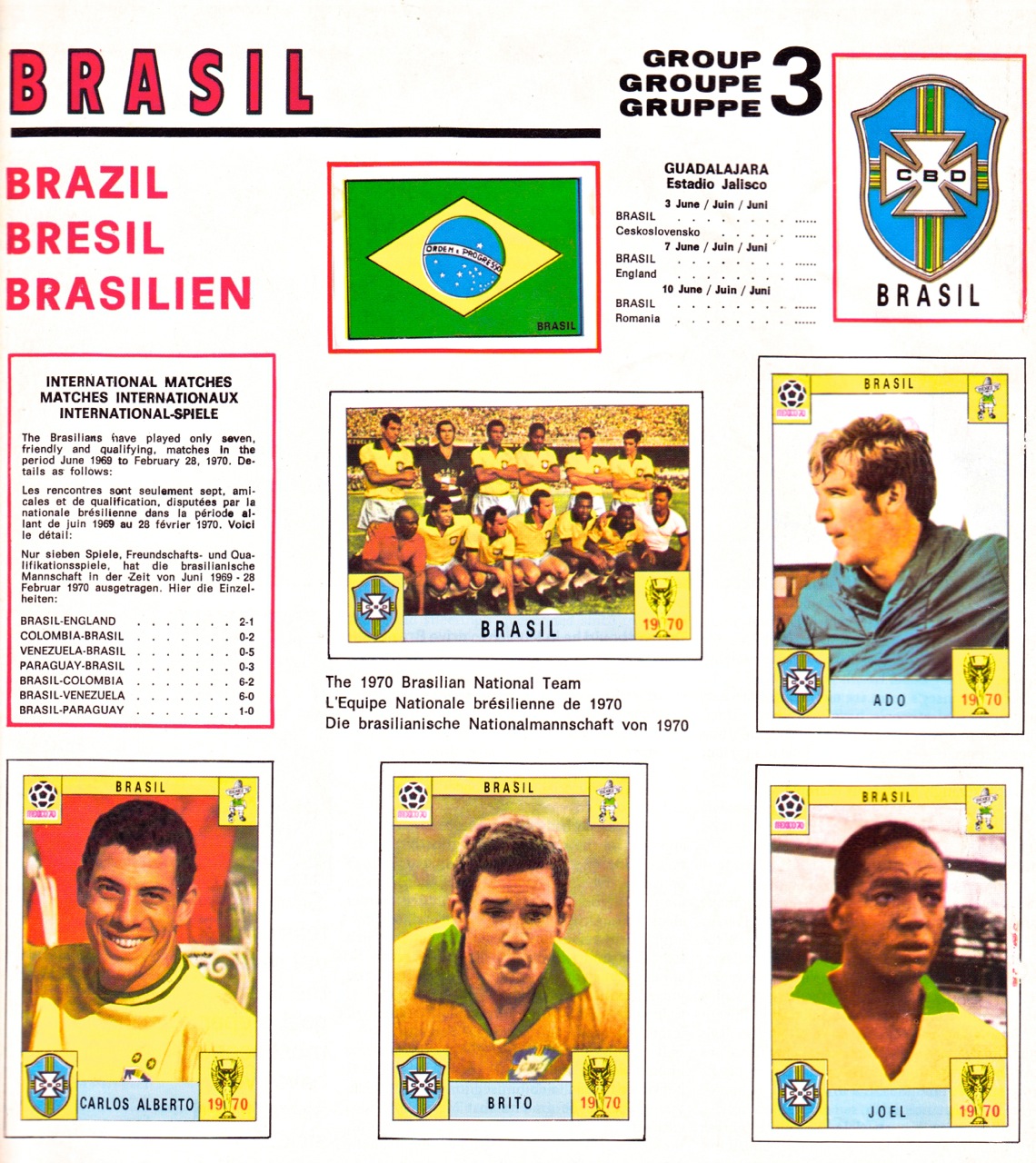
1970 FIFA WORLD CUP. PANINI CARDS

1970 FIFAWORLD CUP. PANINI CARDS


The 1970 FIFA World Cup was the ninth FIFA World Cup, the quadrennial international football championship for men's national teams. Held from 31 May to 21 June in Mexico, it was the first World Cup tournament staged in North America, and the first held outside Europe and South America. Teams representing 75 nations from all six populated continents entered the competition, and its qualification rounds began in May 1968. Fourteen teams qualified from this process to join host nation Mexico and defending champions England in the sixteen-team final tournament. El Salvador, Israel, and Morocco made their first appearances at the final stage, and Peru their first since 1930.


Tuesday, March 21, 2017

TINTIN AU PAYS DE L'OR NOIR.(Tintin en Palestine).

TINTIN AU PAYS DE L'OR NOIR. (Tintin en Palestine )


Ce que je voulais dire, c'est que cette aventure a bien failli ne jamais voir le jour et a connu 3 versions (voire 4 si on inclut quelques changements mineurs d'une version album) en un peu plus de 30 ans ! Qui dit mieux ? Mais faisons un petit cours de rattrapage, si vous le voulez bien.


Première version. Dans ma critique du "Crabe aux Pinces d'Or", je soulignais qu'une première mouture de "Tintin au Pays de l'Or Noir" avait été publiée dans les pages du Petit Vingtième en 39-40. L'histoire originelle collait alors fantastiquement bien avec l'actualité de l'époque, faisant de cette aventure la plus politiquement réaliste depuis "Le Lotus Bleu". D'un côté, nous avions les machinations du Docteur Müller (qui s'est totalement rasé le crâne et laissé poussé la barbe depuis sa première apparition dans "L'île Noire"), agent d'une "mystérieuse puissance" qui tente de saboter l'approvisionnement en pétrole de l'Europe à la veille de la Seconde Guerre mondiale. Tout le monde aura compris que le Docteur travaille en réalité pour l'Allemagne nazie. Mais cette histoire ne se résume pas à ça puisque, d'un autre côté, nous avons une description fort bien vue des conflits opposant Juifs et Arabes dans la Palestine de la fin des années 30. Alors sous mandat britannique depuis 1923, l'émigration juive est fortement encouragée dans le but de créer, à terme, l'État d'Israël, ce qui aboutira à la Grande Révolte Arabe de 36-39, cadre de cet épisode de Tintin. On peut admirer la capacité de Hergé à parler d'un évènement alors relativement peu suivi en Europe et qui accouchera pourtant d'un des conflits majeurs du vingtième siècle. Hergé avait-il plus de flair que nombre de journalistes de l'époque ? Quoi qu'il en soit, le récit est interrompu une première fois lors de l'invasion de la Belgique par l'armée allemande au profit du "Crabe aux Pinces d'Or".


Deuxième version: celle qui suit la chronologie de mes critiques. Nous sommes en 1948. Hergé vient de sortir de sa dépression et est parvenu à achever "Le Temple du Soleil". La vérité, c'est qu'il en a marre de Tintin. Dans une lettre à sa femme, il écrit:

« Quand je dis que je suis blasé, c'est fatigué que je devrais dire. Je suis las de ces éloges ; je suis las de refaire pour la ixième fois le même gag (...). Ce que je fais ne répond plus à une nécessité. Je ne dessine plus comme je respire, comme c'était le cas il n'y a pas tellement longtemps. Tintin, ce n'est plus moi (...). »

De fait, on est bien obligés d'admettre que Hergé a, ces dernières années, parfois tourné un peu en rond avec des thèmes vus et revus (trafics de drogue, bateaux, déserts, prisons...) et de l'humour pas toujours très inspiré à base de chutes et de mandales quelque peu répétitives. Je sais, je sais: les tintinophiles extrémistes vont me menacer d'une fatwa, mais comme c'est Hergé lui-même qui le dit, je ne prends aucun risque ! Tous ces vieux ingrédients, l'auteur va pourtant devoir les reprendre puisqu'il a décidé de profiter de la fin de la censure de 40-45 pour reprendre son récit au pays de l'Or Noir, en pause depuis près de 9 ans sur Müller s'apprêtant à abattre Tintin ! Le petit souci, c'est que, entre temps, il y a Tournesol et surtout l'inséparable ami Haddock qui ont été créés pendant la Guerre. Comment les inclure dans le récit sans devoir tout reconstruire ? La solution trouvée par Hergé est tout simplement brillante puisque il choisit une sorte d'humour basé sur l'absurde, le vrai: écarté de l'aventure dès le début pour obligation professionnelle, le Capitaine revient brusquement en fin d'album sans jamais parvenir à expliquer les raisons de sa présence. Du grand art.


Hergé aura pourtant du mal à terminer cette histoire puisqu'il se tape une seconde dépression née d'une querelle avec son agent et du départ de son collaborateur Jacobs, qui se serait bien vu co-signataire de Tintin. Le fou. Si j'étais dubitatif, au début de ma relecture, quant à l'acharnement de Hergé à vouloir reprendre cette vieille histoire, j'avoue avoir finalement changé d'avis: cette reprise tombait sous le sens tant son avant-gardisme politique la faisait plus que jamais coller à l'actualité de 1948, soit, je le rappelle, 9 ans après l'écriture du scénario ! En effet, les Britanniques, renonçant à s'occuper davantage du conflit qu'ils ont eux-mêmes créé, s'en remettent totalement à l'ONU qui décide, le 29 novembre 1947, de partager la Palestine en deux Etats, juif et arabe. Cette reprise de Tintin ne se place donc plus dans la Grande Révolte Arabe de 1936 mais dans les quelques mois de la guerre civile qui précède le retrait des troupes britanniques, la proclamation d'Indépendance d'Israël le 15 mai 1948 et le début immédiat de la Guerre Israélo-arabe.

Ouf ! Quand je vous disais que cette aventure était solide au niveau du contexte politique, je ne vous mentais pas, hein ? Ha ! Ha ! Pourtant, si vous lisez l'album aujourd'hui, vous ne retrouverez plus rien de tout ça ! Quoi ? Comment ? Par quel blasphème ? Et oui, les éditeurs anglais, toujours présents quand il s'agit de les briser à Hergé, demanderont une refonte moderne de l'album en 1971, comme ils l'avaient déjà fait pour "l'Île Noire". Heureusement, cette fois, l'auteur va résister et... Nooooon ! Mais qu'est-ce que tu fous Georges ? Trop tard ! Plus de Palestine, plus de Juifs, plus de Britanniques: troisième version, qui prend place, cette fois, dans l'état imaginaire du Khemed. Nous perdons en analyse historique ce qu'on gagne en universalité, le pétrole restant, Dieu merci, au centre du scénario, ce qui en fait un album au souffle toujours légèrement acerbe. Si le contexte a été simplifié (ne reste que le conflit entre l'émir Ben Kalish Ezab et le cheik Bab El Ehr), l'intrigue n'en est pas pour autant devenue simpliste: Müller est, à mon sens, un excellent opposant pour Tintin: classe, froid, intelligent et assez mystérieux. De même, l'arrivée d'Abdallah, le fils monstrueux de l'émir, permet de pousser à bout Tintin pour la première fois dans la saga: on le voit secouer le sale gosse, le fesser (mais la scène est "censurée") avant de rire sadiquement de son mépris des lois de l'enfance (je n'invente rien, c'est à la page 51). Un moment délicieux.

Autre très bon moment: l'un des Dupondt donne un coup de pied à l'arrière-train d'un musulman en pleine prière ! Humour totalement innocent (les Dupondt réagissent avec leur bêtise habituelle à la prolifération de mirages dans le désert) mais qui, aujourd'hui, ne passerait certainement plus à cause d'une ignoble censure tacite sur tout ce qui touche à l'Islam (entre autres religions). Ça fait quand même du bien de se souvenir que la liberté d'expression existait, à un certain moment, en Europe... Enfin, il est à noter que la version moderne de l'album a vraiment de la gueule, graphiquement parlant, et que toutes les écritures fantaisistes ont été remplacées par de l'arabe véritable. Un bon point.

On le voit, lassé de ses habitudes artistiques, Hergé ose glisser quelques discrètes nouveautés (caractère et habits de Tintin, non-justification volontaire de la présence de Haddock, désacralisation de l'enfance avec Abdallah qui en prend plein la gueule...) qui ne préparent cependant en rien ses lecteurs au choc de sa prochaine grande aventure spatiale...


PS: Si la version de 1971 reste très agréable, je ne puis que vous conseiller le fac-similé de la version 1950, disponible à la vente, qui vous fera profiter de tout le contexte politique dont je vous ai parlé.